

Making things easy
the universe as ecstasy

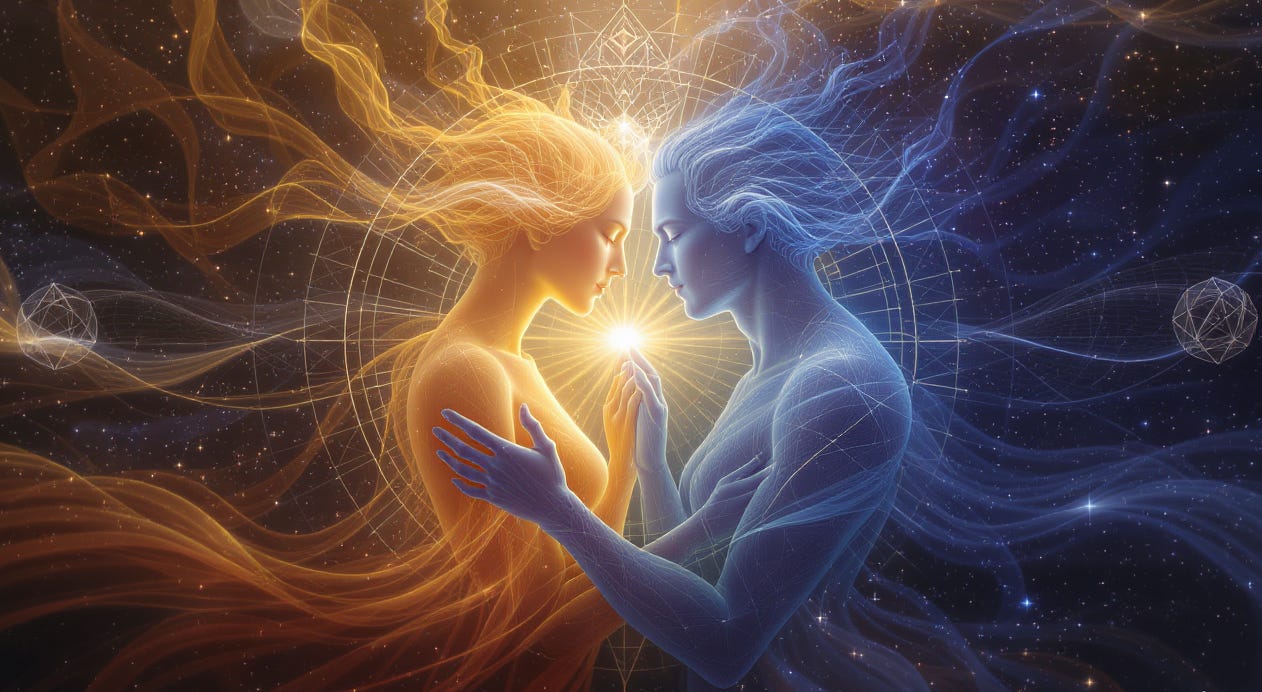
It’s not so easy to understand how the world works. For starters, “the world” is a big place. And, what’s more, there’s no reason to think that the world owes us any kind of explanation. The way the world actually works might be completely inaccessible to us, it might make no ‘sense’ whatsoever to human beings.
And yet the quest persists. People - scientists, philosophers, theologians, electricians, landscape gardeners - continue to insist on figuring out what works and how it works.
This isn’t always a quest for a grand theory of everything. Sometimes the quest has modest goals - like how to build a retaining wall that lasts. But it seems to me that no matter how grand the ambition is, the quest is always the same: we start with what works, we understand why it works, and then we extrapolate from there to some broader theory so that we can succeed with that thing in new situations.
And every now and again people stumble across things that seem, just, well, strange. Unthinkable. And in this space of unthinkably strange things that work, there is something of a convergence between science and philosophical theology.
This convergence is around an idea that philosophers call “monism.”
Let me explain.
Our ordinary experience of life is filled with many things. I, for example, am sitting in my study typing. Around me are different things - three screens, two lamps, a microphone, table, chair and hundreds of books. So many things in my experience right now.
Just take a moment yourself, right now. Look around. Listen. Smell. So much going on around you, so much in your life that is different to you, separate from you, not you.
The One Electron Theory
Now, what might a scientist make of this vast variety? I’ve been bingeing YouTube videos on the great physicist Richard Feynman. The wild thing about Feynman is that he talks about things, sometimes without meaning to, that philosophers and theologians have described for thousands of years.
One of these things is “monism.” I recently listened to him talk about electrons.1 I have always wondered what exactly an electron actually is, as have many people. There is no consensus understanding about this in the scientific community and yet it is widely encountered in experiments as one of the basic building blocks of reality.2
Feynman talks about a conversation he had with another physicist named John Wheeler. In this conversation Wheeler proposed a radical idea. What if there aren’t, as we assume, billions and trillions and gazillions of electrons in the universe? What if there is only one electron. And this electron is tracing backwards and forwards though time and space, like a child’s haphazard colouring in?
According to this theory, you and I just happen to exist at a particular point in this electron’s colouring in of the entirety of everything. Everything around us and inside us just happens to be composed of this electron at those particular points of its meandering journey forwards and backwards in time, through the particular points of space that you and I presently occupy at this specific moment in time.
If this were true then you could say, in a very literal sense, that absolutely everything in the entire universe - everything in my office as I write this - is actually just the one thing. That one electron.3
The Singularity of Bliss
This idea, as strange as it is, is almost exactly the same as one of the main ideas of the Tantric traditions of South Asia.
There are many different Tantric traditions around the world - different flavours, different lineages of thinking and writing that have influenced the religious and spiritual lives of billions of people. And yet this one idea, “monism”, seems to be held in common by almost all of these traditions.
And, amazingly, I think it is likely this Tantric spirituality, built around this crazy idea, is something has touched the lives of more people than any of the world’s organised religions added together.4
The Tantric idea is not about electrons, but about underlying principles. The idea is that the world appears to us as diverse, and this is real and true and accurate. But it is also real and true and accurate to understand all of this diversity as refracted manifestations of a single underlying thing.
In Tantrism it’s not electrons. The idea is that all of the diversity of actual experience is generated by a very specific underlying process, a single type of experience. And that experience is ecstasy.
Tantrism describes this underlying experience in many different ways. It might use the terms “Shiva” and “Shakti,” referring to a male and female deity from Hindu tradition. At other times, it refers to “awareness” and “energy” as ways of thinking about what Shiva and Shakti really are. It might also talk about the masculine and feminine polarities, or about the moon and the sun, or about the absolute ground of being and the dynamic power of manifestation.
But the base is always the same, a process of union, of absolute consciousness united with the dynamic power of creation. According to Tantrism, this single thing is the creative process, the life process, from which the entire universe emerges and on which it is grounded.
Living Easefully
For now, let’s just sit with this massively counter-intuitive idea, that the universe could be just one thing, a union of opposites in ecstatic bliss.. My interest is not just with the pleasure of considering new and challenging ideas. My interest, like the electrician or the landscape gardener, is in what it means, if anything, in practical terms for how you approach your life.
In nineteenth century Europe there was a philosopher named Friedrich Schopenhauer. Schopenhauer had absorbed some of these ideas from the “Far East”, as he would have called it. And he developed a moral philosophy around it. He was a pessimist, convinced that the will to live and the will to suffer are fundamentally the same.
If suffering is the underlying, irreducible, inescapable fact of every living thing, and you are identical with every living thing because of “monism,” then you will dedicate yourself to reducing their suffering in the same way that you work to reduce your own.
Schopenhauer’s conclusion is familiar to us. You probably know it from westernised Buddhism. This is the idea that the moral life is dedicated to compassion in the face of suffering, and that moral action is action that works to reduce or eliminate suffering.
I am not a fan of this pessimistic approach. And I don’t think it’s a very Tantric approach to the the kind of ethics that you get from the “monistic” world view.
Tantrism is basically optimistic. Here the underlying, inescapable and irreducible fact of every living thing is not suffering. It is ecstasy. And not necessarily the kind that you often hear spiritual people talking about, where you find bliss when the “self” dissolves and you lose your identity as you merge with the cosmos.
No. Not that fever dream. And here we come to something really important.
Most religious and spiritual thinking puts you at odds with what that you truly desire. That is, most take a negative stance towards life itself, and its desire to expand, to take pleasure, to revel in things that are easy, comfortable, beautiful.5 The things that support a blissful, ecstatic experience of life.
From the perspective of Tantrism, this means that these other spiritual traditions are pulling you away from your essential nature, and, indeed, the entire character of the cosmos. The basic character of the universe, and therefore, of each individual human being, is the experience of ecstasy.
And this is the light bulb moment, why Tantrism is so different and so successful. It allows, encourages, even demands, that you align yourself with the pleasurable, the easeful, the beautiful, the comfortable. That you seek ecstasy relentlessly as the highest goal and final fulfilment of what it means to be alive.6
In other words, at least from my point of view, Tantrism allows you to see the obvious and to go with it.
This has a beautiful consequence. The war against reality can stop.
You don’t have to fight against reality. Most of us, I believe, have an underlying drive that has been bred in us. It is a warlike drive. The drive to see every day as a battle, success as the spoils of subtle violence against ourselves and those around us.
Tantrism allows you to stop that fight and truly become what you are, with ease, pleasure, joy and love.
The paradox of Tantric ethics, then, is that this seems like it should be the easiest thing in the world. But it’s actually a deep challenge, for all kinds of historical and social reasons.
Give it a go. Organise your life around what gives you bliss and ecstasy…
Neil
Well, to be honest, it sounds like Feynman talking but it might be an AI render. I did verify, though, that this idea is something Feynman spoke about. He even mentioned it in his Nobel Prize acceptance speech.
Or perhaps I should say “building frequencies”, since a lot of physicists seem to think that the underlying material of the universe is not material at all but a wave or field of some kind.
I know that most physicists don’t think that this is literally true, and that the one electron theory has been discredited because of the difference between the measured number of electrons and the measured number of positrons in the universe. But… who knows, unpopular theories have a way of coming back in new ways…
This is a guess, not something I’ve tried to calculate. But if you consider that Tantrism has flourished for at least 7,000 years in the most populous regions of the planet, and that Christianity, for example, has only been around for 2,000 years and has never really made an impact in, say, China or India… well, you get what I’m saying I’m sure.
And this is one reason to love the philosopher Friedrich Nietzsche, his relentless affirmation of life…
For the Sanskrit nerds amongst us… ananda is most often translated as “bliss” but I prefer ecstasy, I guess because it seems to me to retain the fundamental idea that there is an individual self, who is real and not an illusion, an embodied, specific self, who has this experience. It’s not ego-death as much as ego-absolutism.
I’m loving your writing Neil. So beautifully explained.
Thanks Neil. I got a bit confused with this provocation - can you provide links to explanations for all of the terms that you use so I can gain a deeper understanding of all of the pieces…? 🙏